I be strokin’

September was quite a month.

Over the span of two weeks, I had two seizures, or, as they are referred to clinically, “hemorrhagic strokes,” due to a brain bleed.

I don’t like using the “stroke” word. Conjures up bad memories of paralysis and slurred speech and, you know, disability. And we don’t reckon well with disability in our society.

The first occurred on August 28th when I awoke to what I thought were leg cramps, only to realize that something was horribly wrong . The next thing I knew, I was lying on the floor beside my bed, my daughter, who was standing nearby, already having called 911. Naturally, I was  disoriented, but we both remained remarkably calm given the circumstances.

My daughter, as many of you know, is an exemplary human being, by the way. She performs exceptionally well under pressure (takes after her mother).

Two EMS techs promptly arrived, took my vitals, and, since the results were basically “normal ”, actually asked me if I wanted to go to the hospital. Reckoning (correctly) that I’d just had a seizure, I replied, “of course”. I was even able to walk to the gurney.

Twelve hours at U of M hospital and every scan known to man turned up nothing out of the ordinary, so they eventually released me having informed me that a certain percentage of the population will have a seizure in their lives and never have another. Of course, they advised, managing my weight and blood pressure would probably help prevent recurrence and I promised to “do better”, and put this aberration off to work stress and grieving the loss of my wife in April.

In the second instance, two weeks to the day, on September 11th, I was sitting in my home office when I became light-headed and I noticed tingling in my left foot. My daughter placed a second 911 call. This time, I had to be carried to the gurney and was awake for the onset of the second seizure enroute to U of M.

This I do not recommend.

Another round of scans turned up a brain bleed in the right lower quadrant of my dura. I have learned that the dura is a “thick membrane made of dense irregular connective tissue that surrounds the brain and spinal cord.” The source of the bleed was an “AV Fistula” which is “an irregular connection between an artery and a vein.” Or, as one of the smart people at U of M put it “a really gnarly mass of blood vessels that you were probably born with.” The blood leaked from my dura and made contact with my gray matter, which is never a good thing. 

Note: There is a “blood-brain barrier” for a reason, folks.

Do not cross it.

Now here’s the thing: a lot of people are born with AV Fistulas (or develop them at some point) and live their entire lives knowing nothing about them . A very small percentage of people will have them burst because of unmanaged (or poorly managed) high blood pressure and/or stress.

Of course, I was guilty of the former and living through the latter. Fortunately, the only “damage” resulting from this whole affair is some numbness in my left foot, which has greatly improved over time. But the numbness doesn’t hinder me;  I’ve taken to walking about 4 miles a day for exercise, which has helped me drop about 35 pounds and significantly reduced my blood pressure.

What have I learned?

Well, this whole year has taught me that I have control over nothing, something I knew but now truly understand. However I do have responsibilities; to my faith, my family, my job, and myself, to name a few. I’m no martyr, but I really wasn’t looking after that last item on the list. So I’ve made my health a priority. Otherwise, I really cannot live up to any other responsibilities, can I?

What did I get out of all of this?

Certainly, charity and support from family and extended family. “Extended family” being a wholly strange term that usually applies to friends. We generally think of the concept of extended family as “taking the other in,” of extending familial bonds beyond blood ties. Which, wrongly, makes family exclusive. As if, someone is being “let in” to a select club.

In my case, I see it as the other way around. Others extended themselves for me. It’s hard for us as Americans, and especially for Midwesteners, to accept the kindness of others, because we often labor under the notion that we are undeserving of care, of mercy, and, even of love.

But isn’t that the point of mercy, that it’s “unmerited favor?” You cannot “earn” the love of the people that care for you. “Earned love” is just “payback.” Something transactional and rancid and also, unfortunately, all too American.

Besides, “blood ties” are just a matter of circumstance. The instances of blood relatives who cannot stand each other are as common as water. I’m satisfied  with the family that I picked and that picked me.

September was one for the books, as was the entire year. I’m glad that things are as well as they are. 

The title I picked for this essay is a play on words from the title of an old Clarence Carter song (IYKYK). The carnal implications of Mr. Carter’s lyrics aside, there is also a commitment to stay with it, to keep going. 

To persevere. 

At the end of it all, that’s what I’m left with.

In spite of two successive strokes, perhaps, even because of them, I be strokin’.
Words Are Important (and so is owning the means of production)

Okay, so the term “truck farm” has nothing intrinsically to do with trucks. “Truck” is taken from the old north French word “troquer” which means “to barter” or “trade.” And here I’ve been wrong all of this time.

Fact is, many of the roadside farms that I’ve referred to as “Truck Farms” are actually “Market Gardens” in that they provide fresh produce for sale to a local market – usually a city – rather than to feed the farmer’s family.

Evidently, what distinguishes a “market” from a “farm” is the implement used. The former, a hoe, the latter, a plough.

Also, selling wholesale will earn a farmer 10% – 20% of the retail price while selling directly will earn 100% or $120/acre – $1200/acre vs $8k/acre – $20k/acre.

Source:https://en.wikipedia.org/wiki/Market_garden#:~:text=Truck%20farms%20produce%20vegetables%20for,barter%22%20or%20%22exchange%22.

Free-ish

I approach all things surrounding Emancipation with footnotes. For instance:

1) The Emancipation Proclamation did not cover the slave states (Kentucky, Maryland, Delaware, and Missouri) that remained in the Union or were considered “border states”. Lincoln didn’t want to tip them toward the Confederacy. So the main intent couldn’t have been the complete manumission of the enslaved.

2) The announcement at Galveston on “Juneteenth” was not calibrated toward the complete freedom of the formerly enslaved. In fact, it seems to present a set up for the eventual establishment of Jim Crow. From General Order 3: “The freed are advised to remain at their present homes, and work for wages. They are informed that they will not be allowed to collect at military posts; and that they will not be supported in idleness either there or elsewhere.” Note that there are no provisos given for the former enslavers (and no mention of “back pay” for the formerly enslaved).

Ambivalence

It’s always ambivalence.

That’s the general feeling I associate with America. Take “General Order Number 3”, the official document associated with Juneteenth which says in part: "The freedmen are advised to remain quietly at their present homes and work for wages. They are informed that they will not be allowed to collect at military posts and that they will not be supported in idleness either there or elsewhere."

There’s always that parting shot,

“…they will not be allowed to collect at military posts and that they will not be supported in idleness either there or elsewhere.”

It’s the loophole that Jim Crow and The Black Codes ride through.

And remember, The Emancipation Proclamation freed the enslaved of the Confederacy on January 1, 1863. Also keep in mind that there were Union states where black citizens remained enslaved until the passage of the 13th Amendment.

So, let’s recap: Two and a half years after The Emancipation Proclamation which preserved slavery in Union territory, the enslaved of Texas were informed that they had been freed, conditional on a broad interpretation of their “good behavior” (check out that other loophole in the 13th Amendment).

Hence the source of my ambivalence.

My daughter has a Juneteenth poster somewhere around here inscribed with the tag #freeish

Here’s to a day when we’re all free.

https://en.m.wikipedia.org/wiki/General_Order_No._3#Physical_document

Blot

“However our present interests may restrain us within our own limits, it is impossible not to look forward to distant times, when our rapid multiplication will expand itself beyond those limits, & cover the whole northern, if not the southern continent, with a people speaking a same language, governed in similar forms, & by similar laws; nor can we contemplate with satisfaction either blot or mixture on that surface.” Thomas Jefferson to James Monroe, November 24, 1801

“… nor can we contemplate with satisfaction either blot or mixture on the surface.” Ironic, right? Because based on not so recent scholarship, Thomas Jefferson had little reservation about mixing with at least one of the “blots” on at least six different occasions.

As much as we like to believe the origins of the American character are forged in democracy & fraternity, we’d be negligent if we didn’t consider the very strong impulses toward imperialism and white supremacy ably carried by the vessel of “Manifest Destiny.” Jefferson’s letter to James Monroe, excerpted above, was written roughly three years before he commissioned Lewis and Clark to map the Northwest Territory which he’d just bought from France, ignoring the sovereignty of the many nations of indigenous people who’d already live on this continent for centuries.

Lewis & Clark set out from St. Louis, the very site of the Cahokians, the “Mound Builders” who had established a vast civilization some 800 years prior. They built a network of at least 70 mounds used for festivals, religious rituals, and observing the stars. I camped in the state park near the few remaining mounds as a Boy Scout. We were told that they were crude burial grounds. The area surrounding the park has been zoned for industrial and commercial use. The nearby exits look like just about every other off-ramp in America, a mixture of gas stations, big box stores, and fast food franchises. Which is what it is, right? The new always supplants the old. Every city is built over the bones of earlier attempts at civilization.

But consider that Cahokia and the rest of the continental U.S. weren’t “settled” as much as taken by force. The civilizations already established on the land weren’t supplanted. They were obliterated. The bones of their prior cities ground to dust, or, as in the case of the Cahokia mounds, used to backfill the foundations of the new cities.

Tertium Quid

Black citizens have been a “problem to be solved” since the inception of this country. The Founders never intended to include black Americans as American citizens. This is not a shock to anyone paying attention. During the Constitutional Convention, the nature of the problem had nothing to do with the humanity of black citizens – the morality of which, had already been decided – but whether to classify us as “property” or include us as members of households.

Property could not be counted for the purposes of congressional representation. On the other hand, male members of households could potentially be afforded the right to vote. Southern states had a vested interest in maximizing their overall representation and in suppressing the black vote. The northern states interests were diametrically opposed to augmenting the southern vote and there were some calls among northern Abolitionists to grant full citizenship to the enslaved.

What to do?

Article 1, Section 2, Clause 3 of the US Constitution states:

Representatives and direct Taxes shall be apportioned among the several States which may be included within this Union, according to their respective Numbers, which shall be determined by adding to the whole Number of free Persons, including those bound to Service for a Term of Years, and excluding Indians not taxedthree fifths of all other Persons.”

“…three fifths of all other Persons”… they couldn’t even say it with their full chest. The Three-Fifths clause simultaneously increased the representation of southern states while it reduced the corresponding tax burden. Classic having your cake and eating it too.

How did representatives from northern states agree to selling out the masses of black humanity held in bondage in the south? I think it was for the sake of unity, the same principle that continues to betray black citizens to this day, and since black people aren’t considered fully human, it’s easier to betray us.

In “The Souls of Black Folk”, W.E.B DuBois described black humanity as a “third thing” or tertium quid:

The second thought streaming from the death-ship and the curving river is the thought of the older South,–the sincere and passionate belief that somewhere between men and cattle, God created a tertium quid, and called it a Negro,–a clownish, simple creature, at times even lovable within its limitations, but straitly foreordained to walk within the Veil. To be sure, behind the thought lurks the afterthought,–some of them with favoring chance might become men, but in sheer self-defence we dare not let them, and we build about them walls so high, and hang between them and the light a veil so thick, that they shall not even think of breaking through.

Betrayal is very common occurrence among peers, a staple theme running through all literature. How simpler then to betray a class of people who aren’t even considered fully human? In point of fact, the purpose of the Three-Fifths compromise for the northern states was to blunt the effect of the larger populations of the southern states. However, had the north pressed to declare enslaved black Americans as “property” the south would have been allotted 33 representatives in the House of Representatives. But with the Compromise, that number rose to 47.

Ironically, Frederick Douglass defends the Three-Fifths Compromise in a speech before the Scottish Anti-Slavery Society in Glasgow, Scotland on March 26, 1860:

A black man in a free State is worth just two-fifths more than a black man in a slave State, as a basis of political power under the Constitution. Therefore, instead of encouraging slavery, the Constitution encourages freedom by giving an increase of “two-fifths” of political power to free over slave States. So much for the three-fifths clause; taking it at is worst, it still leans to freedom, not slavery; for, be it remembered that the Constitution nowhere forbids a coloured man to vote.

I’d note however that he implicitly acknowledges the innate humanity of black citizens and, in my view, provides an intention toward black freedom that the drafters never really intended. At first glance, a “left-handed compliment” at best, or perhaps, the ultimate expression of “finding the silver lining.” However, I believe, in fact, that it’s a brilliant use of rhetoric. Douglass plainly states that freedom is superior to slavery and “obviously” the aim of the Constitution. Furthermore, nowhere in the Constitution is there an abolition against the black vote. So, therefore…

The south hasn’t needed masses of black labor for quite some time which is increasingly the issue with labor in general.

What do you do with people you no longer need?

If said people aren’t recognized as fully human in the first place, it’s fairly easy for the institutions which have historically exploited them to dispose of them by the most expedient (and often profitable) means possible and for historical “allies” to look the other way.

Temptation

I cannot begin to explain how infuriating I find the current Senate spectacle.
No job is worth this.
To be publicly debased for a Senator’s political cred is beyond the pale.
But black citizens have it almost encoded in our DNA that this is “the price of the ticket.” That our qualifications and our behavior have to be absolutely immaculate to even be considered for anything that whites have historically dominated, and that this is somehow a good thing.
I’ve said elsewhere that “I don’t hate America but some says I’m tempted.”

Today is one of those days.

We’re Lying to You Most of The Time

“‘You’re acting all the time when you’re black’.” And it’s true. Black people are acting out roles every day in this country just to keep on getting by. If white people really knew what was on most black people’s minds it would scare them to death.” – Miles Davis, from “Miles – The Autobiography”

I offer this as an exhibit for anyone concerned about impediments to free speech as I believe the Times Editorial Board characterized it. I use it to remind myself once again that the concept of “cancel culture” is another tool of white supremacy. For black citizens it could mean your life. I’m thinking of Fred Hampton, MLK, & Malcolm X. They were “canceled” for just speaking the truth. For having the nerve to suggest that that full citizenship for black Americans, for the poor and marginalized, was long overdue. For just suggesting that America needed to change.

“If white people really knew what was on most black people’s minds it would scare them to death.” And when white people get scared, black people die. That’s why “lying to white folks” comes as natural to black people as breathing.

To be able to speak your mind without the threat of criticism, or even shame, is a privilege enjoyed at the expense of others. If the only threat to your ability to speak freely is criticism and shame, you’re still privileged.

When you assume…

Some comments:

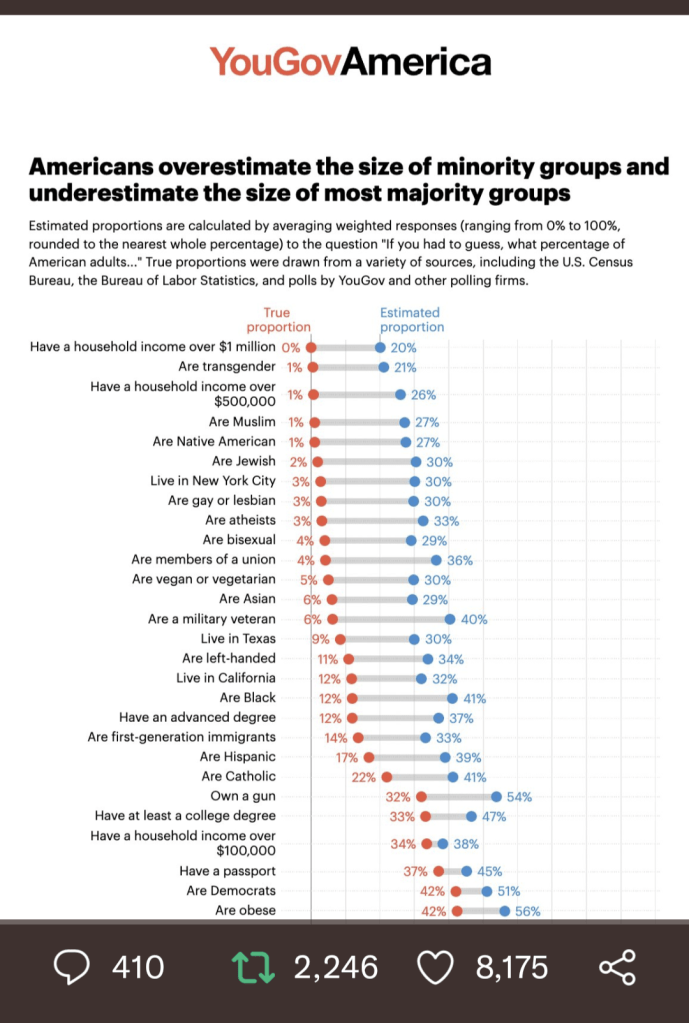
1. Black people have consistently been roughly 12% of the U.S. population for quite some time. I would like to see the scholarship around this. I’m sure some of it centers around “how *black* is defined.”

2. The amount of power granted “leaders” who gin up fear around Muslim & LGBTQ Americans, given their extraordinarily small numbers, is frightening. Fear and Loathing of the “other” has become a monstrous feature of the American operating system.

3. Y’all ain’t never gonna get rich. And rich people ain’t sharing.

4. We love guns. That’s 100 million guns folks. And note that roughly one-third of Americans own enough weapons to arm every man woman and child in this country.

https://acasignups.net/22/03/17/redblue-covid-divide-includes-pretty-eyebrow-raising-coincidental-data-point

Why, Black History

“The story of the master never wanted for narrators” – Frederick Douglass. My stock answer for whenever anybody comes after black history from now on.

The epigram, “History is written by the victors,” is often attributed to Churchill, which I’ve learned is not entirely true. For my part, I find that history is frequently misread as it is continually being re-intrerpreted and uncovered. History is like self discovery. It’s messy and often painful and, if you spend enough time with it, you realize that you cannot tell one pain from the other.

History is not a fixed point in time. It’s never really “settled”. It is a story that never finishes.