THE CASE AGAINST UNIFICATION

(Text of a talk given in February of 2021 to The Livingston Diversity Council)

With calls again for “going back to normal” I think it’s time for a repost. The very real concerns for public health aside, I’m making the case to move forward – away from “normal” – not back. In large, due to fact that we really don’t have a true accounting of how we go here.

After 4 explosive years under our last chief executive, a very contentious election, and a full-blown insurrection on January 6th (2020), there is a strong call in the land for unification. In fact, it is a regular talking point of our recently elected president. We live in frightening times. Threatening inflammatory rhetoric has been turned up “well past eleven” for quite some time. And there is still a very real threat of fascism ascending to the federal seat of power under an authoritative strongman. Besides, our country is under the threat of economic collapse brought on by a world-wide pandemic. Wouldn’t now be the time to unify under the American banner?

Well, it depends. Unification for whom? Certainly not for black Americans. In fact, unification is a direct threat to the welfare of black citizens. We only have to look to history to understand why.

At the end of the Civil War a crowd gathered on the front lawn of the White House in celebration of the defeat of the Confederacy, clamoring for a speech from President Abraham Lincoln. Lincoln respectfully declined and promised a speech for the following night. In consolation, he requested that the Marine band play “Dixie.” Lincoln declared, “I have always thought ‘Dixie’ one of the best tunes I have ever heard. Our adversaries over the way attempted to appropriate it, but I insisted yesterday that we fairly captured it.” As the crowd cheered him on, he added, “It is good to show the rebels that with us they will be free to hear it again.” In choosing to welcome the Union’s “adversaries” back into the fold with that song, Lincoln helped set a pattern for the betrayal of the formerly enslaved for decades. Not only was “Dixie” enjoyed by the throng on the White House lawn that day, it became emblematic, along with the rebel battle flag, of the oppression and degradation of black Americans for decades to come. Oppression and degradation that began with the end of the Reconstruction era.

Contrary to what generations of children were taught in school, the Reconstruction Era immediately after the Civil War was very successful. For 11 years the formerly enslaved, aided by the protection of Union troops and with the sanction of the federal government, worked tirelessly to secure full citizenship in these United States. Ironically it was “radical abolitionist wing of the Republican Party” in opposition to the efforts of Lincoln’s successor, Andrew Johnson, who triggered the passage of the Reconstruction Act of 1867. Included in the law were the following measures:

• It divided the south into 5 districts governed by military governors until such a time that acceptable state constitutions could be written that eliminated all vestiges of slavery.

• All males, regardless of race, excluding former Confederate leaders, were allowed to participate in the constitutional conventions forming the new state governments.

• These new state constitutions were required to provide universal voting rights for all men regardless of race.

• States were required to ratify the 14th Amendment, which guaranteed black citizenship, in order to be readmitted to the Union.

Marinate on this a minute if you will. 1867, The Republican Party calling for full citizenship rights of black Americans at the exclusion of former Confederates from involvement in the process. Confederates who were legally barred from interfering in the lives of black citizens. Think of what could have happened if this had continued into the 20th century. Think of what highly motivated, industrious, and capable men and women could have done when granted the freedom afforded white Americans, afforded the often celebrated European immigrants, to pursue the full rights and benefits of American citizenship. Unfettered by Jim Crow, allowed to flourish as their imaginations and their industry dictated.

What did happen? As I said, for 11 years the United States actually began to live up to its promise. Congress passed the Freedman’s Bureau and the Civil Rights Bills, successfully overriding Andrew Johnson’s vetoes to pass them into law. They even moved to impeach Johnson.

Ulysses S. Grant, elected after Johnson, supported Reconstruction and enforced the protection of African Americans. He used another law, The Enforcement Act, to put down the Ku Klux Klan, essentially wiping them out by 1872. Grant integrated the federal ranks, extending job opportunities to black Americans. He championed equal rights. He supported a 2nd Civil Rights Act of 1875. During this era, black Americans enjoyed the highest representation in government ever. Across the south and in Missouri, there were 1517 black state officeholders, 6 of them lieutenant governors. At the federal level 16 congressmen, 185 federal officeholders in all.

Furthermore, across the south, local officials had great success in creating integrated governance. Accordingly, the formerly enslaved prospered in land and business ownership, in education, in all phases of life.

That is, until the cause of white unity became more important. The election of 1876 did not produce a clear electoral winner between Republican Rutherford B. Hayes and Democrat Samuel Tilden. Neither had the 184 electoral votes required at the time to be declared the winner. The parties formed a bipartisan Electoral Commission to decide the race. To break the deadlock, the 2 parties came to an agreement to provide Hayes 20 disputed electoral votes to win the vote. To secure the support of southern Democrats, the terms of the agreement included that the federal government would remove all troops remaining in southern states and that southern democrats had the right to deal with black citizens without “northern interference.”

Unity achieved.

Southern whites immediately resurrected the Ku Klux Klan and began a campaign of violence and terror that by 1905 had removed any significant traces of black political power.

In 1898, unified in their opposition of integration, the white population of Wilmington, South Carolina staged an actual coup. A mob of 2000 white men overthrew the legitimately elected local Fusionist party consisting of black and white leadership of the city. They expelled city leadership who would comply, murdered those who wouldn’t. They destroyed private property and businesses, burned the only black newspaper to the ground and killed an estimated 300 people. By this point, Mississippi had passed a new Constitution which disenfranchised black voters. South Carolina and the rest of the south followed suit. In effect, “whiteness” nullified the 14th Amendment and overrode any claims of legal citizenship by black citizens. The Wilmington Coup appears to be the watershed moment that cemented this notion across the land. And it became the template for the unity of whites at the expense of black lives and livelihoods for the decades to come.

In a show of labor unity and solidarity a series of massacres the summer of 1917 in East St. Louis, Illinois left an estimated 250 black citizens dead and another 6000 homeless. The violence was triggered in reaction to the recruitment of black workers to replace white union employees striking the aluminum and meatpacking industries. The very same unions that had denied black workers membership. Reporting at the time indicated that East St. Louis’s white police force either ignored or participated in the violence. And the National Guard, called in by Illinois Governor, Frank Lowden, largely allowed the massacre to continue. Much of East St. Louis’s black population fled over the bridges spanning the Mississippi river, connecting their city to St. Louis, Missouri, never to return.

In the summer of 1919, Eugene Williams a black 17 year old living in Chicago was playing on raft in Lake Michigan with friends. The raft drifted into a white swimming area and angry white beach goers began throwing rocks at the raft. Williams fell in and drowned because, according to the official coroner’s report, the rocks that white bathers continued to throw at him prevented him from coming ashore. The white beach goers were unified under the need to keep recreation strictly segregated.

When black beach goers on the scene complained, they were attacked by a white mob that spread into the black community. The rioting continued for 5 days. As with East St. Louis, police arrested black participants but steadfastly refused to arrest whites. At the end of it 15 whites and 23 blacks were killed. 500 total were injured, over 60% of them black. Over 1000 black families were left homeless. Not one white rioter was convicted of a crime. That summer there were similar incidents in Washington, D.C., Knoxville, Tennessee, Longview, Texas, Phillips County, Arkansas, and Omaha, Nebraska.

In 1921 white rioters, unified by the mandate to protect a white woman’s virtue, destroyed over 35 blocks of Tulsa, Oklahoma, the Greenwood community, also known as “Black Wall Street”. Greenwood had been organized in 1906 after Booker T. Washington toured the Arkansas Indian Territory and Oklahoma.

At the time, Greenwood was the wealthiest black community in the nation. It contained several grocers, 2 newspapers, 2 movie theaters, several nightclubs and churches. Estimates have ranged from 75 to 300 black citizens killed. The violence was precipitated by the claim that Dick Rowland, a 19 year old black shoe shiner, had assaulted Sarah Page, a 17 year old white elevator operator. Note that much of the violence was organized by the very same Klan that US Grant had eliminated in 1872.

Rowland was taken into custody and word quickly spread through the black community that a crowd of white men was gathering at the jail to likely lynch the young man. A group of 75 black men stationed themselves outside the jail to protect Rowland. Upon the assurance of the local sheriff that Rowland would be protected, the black citizens agreed to disperse. As they were leaving, a member of the white mob attempted to disarm a black man and the confrontation devolved into a firefight. 12 men were killed, 2 black, 10 white. White rioters gathered and rampaged through the black community that night and into the morning. At least one plane was reported to fire on the black community from the air. Reportedly, the first instance of the use of air power on American soil. When the dust settled, 10,000 black people were left homeless. Property damage estimates ran to more than $1.5 million. There are other examples that echo through our collective history; Detroit, 1943, St. Louis 1949, Charleston in 2015, Charlottesville in 2017. And while last 2 instances involved single actors, they were by no means “lone operatives” as they were radicalized by their exposure, in unity, with like-minded affiliates.

Black History is the story of the struggle for liberation. Starting effectively in 1619 on through to Ferguson (Mike Brown), Staten Island (Eric Garner) and Kenosha (Jacob Blake) to name just a few. We struggle to liberate ourselves from racism which, I take pains to emphasize, is not a defect of individuals, but a system and structure designed to serve white supremacy, to serve white people who often unify in its service. Often violently.

I recently heard the celebrated activist, Angela Davis, say that “unity is an abstract.” She had been asked about the concept of America unifying in this moment in history. Dr. Davis suggested that to be effective, people must unify around “something.” She suggested that unity in struggle makes sense. Otherwise, she implied, it’s just lip service. The struggle for black liberation goes beyond allyship, beyond just “listening” and lip service to commitment and “action.” Let our country unify around liberation of its black citizens. Too often it has unified against us.
We’re All Villains

One of my favorite pieces of family lore revolves around my great-grandfather, Robert, called Shack, who purportedly was one of the most successful bootleggers in West Tennessee during Prohibition.

His son, my great uncle, also called Robert, loved to brag that Shack was never caught plying his trade. Shack often boasted that he never worked an honest day in his life, supporting his family in fine fashion by producing bootleg whiskey and shooting dice.

In one instance, the local sheriff assigned two deputies to follow Robert The Elder around for a week, knowing that the local juke joint was due for a resupply.

On Friday afternoon, the deputies trailed Shack in a police cruiser as he made the four mile walk into town. Even stopping to frisk him a couple of times to assure themselves that Shack carried no contraband.

Satisfied they’d done their job, they returned to headquarters to report on a successful completion to their assignment.

Nothing could have been further from the truth.

The fully resupplied juke joint conducted Friday night business uninterrupted. One can only imagine the embarrassment at headquarters the next day. How did Shack accomplish this blatant act of subterfuge?

This is the part of the story that Uncle Robert took particular glee in telling.

Shack delivered his specific brand of moonshine in concentrated form – much like orange juice – small enough to fit into a coffee can which he wrapped in shipping paper. He blended the final product on site.

To sneak his package past his police tail he attached one end of a wire to the package and threw it into the drainage ditch alongside the road. The other end of the wire went into his pocket. He strolled into town walking his can of hootch like it was a pet dog. The wire was thin enough that the deputies could not see it from their vehicle and whenever Shack saw them approach, he merely dropped the wire, stood patiently while they frisked him, and then retrieved the wire once they’d left.

Tennessee of that day was an openly racist, segregated, hierarchy, though one could make the argument that little has changed in the material lives of Black Tennesseans since. Schools are now segregated by tax codes and vouchers rather than law, for instance. The legacy of slavery hung heavily over Black men like Shack in pre-World War II Tennessee. The odds were stacked against him from birth. He had little to no chance of learning to read, let alone getting an education and his life was in constant risk of racial violence. The Klan, which briefly became active at the end of the Civil War to stem the tide of black suffrage, experienced a resurgence in the early 20th Century after the release of D.W. Griffith’s “Birth of A Nation” which glorified the “knights” of the Klan as the protectors of white society. President Woodrow Wilson praised the film after a private screening at the White House.

Another piece of family lore involves the lynching of Joe Boxley, a farmhand of limited mental capacity, who worked for a white family in Crockett County, Tennessee, where Shack plied his trade. Like Potiphar’s wife of the Old Testament, the matriarch of the family was said to relentlessly pursue Joe in a clandestine attempt to seduce him. Joe had enough sense to never be caught alone with a white woman, but his family was broke enough that he couldn’t afford to quit the job. Eventually, the woman fell ill of a mysterious malady and spent several days in bed barely conscious. When she finally came out of her stupor her first words were, “Joe?”

Such was the backdrop of the times as Shack prepared, packaged, and distributed his wares. We, his descendants, have portrayed him as an anti-hero of sorts, taking the bad hand dealt him and running a successful enterprise in “the underground economy.” Accordingly, his family wanted for nothing. Yet there were repercussions.

In later years Uncle Robert often noted that while they were at Shack’s back door on Saturday night for a personal sample of “the recipe” (they couldn’t well be seen at the local juke), the upstanding members of Crockett County’s Black society vilified Shack on Sunday thru Friday. So much so that Uncle Robert, Shack’s only son, a star athlete, and standout student was shunned by polite society. Hardened by the hypocrisy of it all, Uncle Robert determined that “if they were going to brand me a ‘bad nigger’ I’d be the ‘bad-est nigger’ imaginable.”

Never to do anything half assed, Robert Glenn fully threw himself into his new chosen path.  He made his living running his father’s whiskey and illegal gambling. Mostly dice. Unlike Shack, he paid little heed to those he crossed on either side of the law. Reflecting back decades later he would wonder if he’d manifested a type of death wish. By his own admission, he took unimaginable, unnecessary risks, often escaping disaster by a hair’s breadth.

But, in his eyes at least, he was honest about who he was and what he was doing even if his path led ultimately to self-destruction.

Eventually though, after one close call too many, he’d had enough. With few options and nowhere to go (Shack believed in “every pot sitting on its own bottom”), he added a couple of years to his age and enlisted in the army around the time armed services cleared the way for Black soldiers to fight in World War II. Uncle Robert was shipped to the European theater where he served with distinction. But that’s a story for another day.

What I’m interested in is the justifications, lies really, Uncle Robert and Shack had for their behavior.

We’re all the heroes in our own stories, usually underdogs, regularly misunderstood, often tragic. We make our personal odysseys against inconceivable odds to get the girl/right the wrong/defeat the monster.

Or so we tell ourselves.

To be clear, the obstacles that Shack and his son faced were ready made for a hero’s journey: a rigged justice system, legal slavery in the form of Jim Crow segregation and sharecropping, the constant threat of white violence, and the further indignity of the hypocritical condemnation of “proper” Black society.

How did they choose to respond?

Shack made and sold illegal whiskey, an unregulated, often dangerous substance, largely to his own community. In his times, the main risks of consuming moonshine were from poisoning from contaminants like lead, methanol, and arsenic. The results were often blindness, kidney damage, and death. I have no way of knowing to what level Shack maintained his quality controls. But it is quite possible, Shack made a very comfortable living from the high likelihood of poisoning his own people. Now, let’s assume for a moment that no one got sick or died from his “brew.”

Put bluntly, given the racial disparities of the Depression Era, pre-war South, Shack made a living salving the misery of his neighbors with an addictive substance.

Likewise, Shack’s son, my Uncle Robert, profited from the sale of the same illegal (probably tainted) whiskey, and by his own admission, “raised as much hell” as he could. In fact, he delighted in it, particularly with respect to the “fairer sex.” He told me that he never hurt anyone physically other than in self-defense. Though short on details, he confessed that he left “a trail of misery” in his wake in those days.

They were both villains of the highest order; exploitive, manipulative, heartless. Shack plied his trade in the manner of the modern tech bro sociopath. Beholding only to the bottom line. What did he care for the lives his product damaged? They consumed it of their own free will.

Robert merely met the community standards set before him. He often said that he “gave ’em what they wanted” or expected at least.

Did either of them interpret their behavior as villainy?

Of course not.

Do you?

We all manufacture justifications for our wickedness. Justifications often built on the lies we tell ourselves so that we can stand ourselves. Ironically, we often think too highly of ourselves because we fear that we are worthless. We create heroic narratives for our behavior to distract our minds from the compromises we make to our integrity, the harm we cause, the manner in which we exploit others for gain. Rather than make amends we pursue delusion. Making amends would require us to abandon our carefully constructed fantasies that undergird our self-image.

We may not lynch or poison our neighbors or exploit our peers. But we are often curt and rude to elderly relatives because of questions asked one time too many (there’s even a limit to the allowance for senility). We will unduly punish a child over a minor infraction behind a particularly frustrating commute home. We will lash out a colleague in jealousy.

And then we expand on the assumed affrontery to avoid addressing the issues that drive our behavior. We construct a hero’s narrative to justify our transgressions. Because we’re all afraid of facing what we don’t like about ourselves. We’re all warping the concept of morality to fit the shape of our fantasies. We’re all taking shortcuts to our desired outcomes. We’re all constantly looking for excuses for our questionable behavior (and doing it loud and wrong).

We’re all villains.

Compared To What…

When I was in college 100 years ago I learned that while there were objective measures of art, for instance, line, color usage, brush strokes, harmonic progression, etc, art is best judged on how effective it is rather than if “I like it” or even “get it.”

That effective art resonates. That it speaks to the layers of the human condition.

Furthermore, we bring our own perspectives to art and that our perspectives change over time. For example, when I was growing up, my dad wore the groove out of “Compared To What” by Les McCann & Ed Harris. It did not move me back then. Probably scared me a little. But now, with 6 decades behind me, it’s my “Hallelujah Chorus.”

What Lamar left us with Sunday night was art. There were layers upon layers.

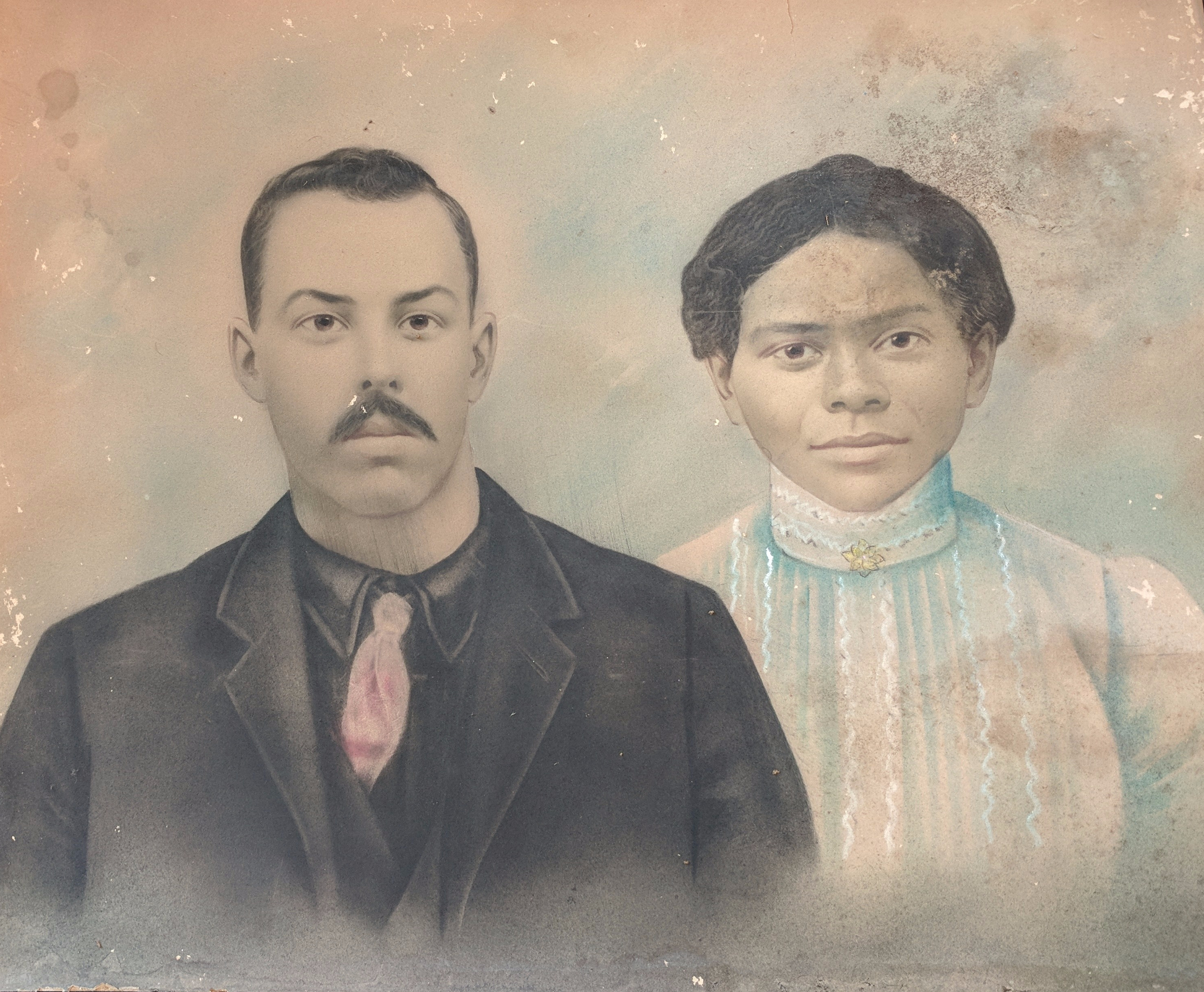
Frank

Frank 1

This is Frank Beard, my maternal grandmother’s father with his first wife. As far as I know, this is not a drawing. The picture was taken in black and white and then colored in after. We removed it from a frame that was as warped and weathered as the picture; a massive, heavy thing, ornately carved.

If I recall correctly, Frank was married 4 times. The woman pictured, his first wife. She bore him 2 sons before she died. His second was my grandmother’s mother who died when my grandmother was quite young. Frank’s 3rd wife treated my grandmother and her brothers very cruelly. The boys were beaten so severely they passed blood. This woman’s 2 daughters tormented my grandmother while the boys were in the field working alongside Frank. These “wicked stepsisters” dictated to my grandmother and her siblings how much they could eat. Consequently, they were underfed. My grandmother told stories of scrounging for scraps in the chicken yard.

Here’s the thing: Frank was evidently oblivious to all of this. It was not until he was alerted by a cousin, a woman who raised the alarm at the poor condition of his children, that he took action. He divorced Wife Number 3 and married a 4th time. Wife Number 4 proved to be a vast improvement.

I used to put off Frank’s neglect of his children to the times in which he lived. Caring for the brood was “women’s work” and none of his concern. He paid no real attention to the physical condition of his children. Made no notice of the interactions between them. Caught no signs of menace between his wife and her stepchildren. He had to attend to his farm. The day to day of his family passed his notice.

What are we allowing to pass our notice? Apparently quite a bit if the latest news is any indication. What does is say about the times in which we live? What is more important to us than addressing neglect and abuse in our very midst?

It’s said that, on her death bed, Wife Number 3 called Frank to her bedside. She claimed to see a finger writing on the wall so fast that she couldn’t read it. It was giving an accounting of her past sins.

No one knows if Frank forgave her.